

If your bakkie canopy door won’t stay up, drifts down while you’re loading or drops onto your head, the problem is almost always the canopy door shocks. These small gas struts carry the weight of a lift-up door and hold it open, and like any wearing part, they lose strength over time. This guide explains what canopy door shocks are, how to choose the right size and force, how to fit them so they last, and how to tell when it’s time for a new pair.
Hinge Master Sales is based in Sebenza, Edenvale, and has supplied body components and hardware to the canopy, bus, container, trailer and truck body-building industries since 1989, first as a CC and as a (Pty) Ltd since 1994. We sell gas stays, fittings and brackets for canopy doors, lids and hatches.
What are canopy door shocks?
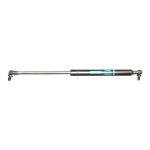
“Canopy door shocks” is the everyday name for the gas struts on a canopy’s lift-up side doors and rear door. You’ll also hear them called gas stays, gas springs, gas lifts or canopy struts. They’re all the same part: a sealed cylinder filled with pressurised gas, usually nitrogen, with a piston and rod that slide in and out.
When the rod is pushed in, the gas is compressed and pushes back. That push, measured in newtons (N), supports the weight of the door. A small amount of oil inside the cylinder damps the movement, so the door slows near the end of its travel instead of slamming open. For more technical background, see this overview of gas springs.
Unlike a shock absorber on a suspension, a canopy door shock isn’t there to soak up bumps. Its job is to lift and hold. That’s why matching the force to the door matters so much: too little and the door creeps down, too much and it flies open, strains the hinges and is hard to close.
Where canopy door shocks are used
- Canopy side doors: the lift-up gull-wing or side-access doors on workman’s and leisure canopies.
- Canopy rear doors: top-hinged rear doors and windows.
- Service bodies and toolboxes: heavy lids and hatches that must stay open while you work.
- Trailers: enclosed trailer lids, camping trailer hatches and storage boxes.
- Truck and bus bodies: access panels, luggage flaps and equipment compartments.
How to choose the right canopy door shocks: 6 checks
1. Weigh the door
Start with the weight of the door, including everything fixed to it, such as locks, handles, glass, racks or lights. If you can’t remove the door, rest one edge on a bathroom scale with the other on the hinge to get a rough figure.
2. Measure the door and hinge position
Measure the door’s length from the hinge line and note where its centre of gravity is. On a flat, even door, it’s roughly halfway. The further the weight sits from the hinge, the more force the shocks must provide.
3. Work out the force
The force you need depends on the door weight, the distance from the hinge to the centre of gravity, where the shocks are mounted and how many you use. Rather than guessing, start with our gas stay calculation chart, or send us the measurements and we’ll help you work it out.
4. Choose the length and stroke
Measure the distance between the two mounting points with the door closed and with it fully open. The shock’s extended length must match the open position, and its compressed length must fit the closed position, with a little spare travel so it never bottoms out. Our gas stay size and code chart lists the sizes and codes so you can match them.
5. One shock or two?
Wide or heavy canopy doors usually need a pair, one on each side, so the door lifts evenly without twisting. With two, each shock carries roughly half the total force.
6. Pick the right end fittings and brackets
Canopy door shocks connect to the door and frame through end fittings, such as ball sockets or eyelets, mounted on brackets. Check that the fittings match your brackets before you order. We supply gas stay fittings and the gas stay bracket.
Canopy door shock quick-reference table
| Measurement or choice | Why it matters | Tip |
|---|---|---|
| Door weight | Sets the force needed | Include locks, handles, glass and anything mounted on the door |
| Hinge to centre of gravity | More distance needs more force | On a flat, even door, measure to the middle |
| Extended length | Must match the fully open position | Measure between mounting points with the door open |
| Compressed length | Must fit with the door closed | Leave a little travel so the shock never bottoms out |
| Number of shocks | Even lift without twisting | Use a pair on wide or heavy doors |
| End fittings and brackets | Secure, correctly aligned mounting | Match the fitting type to your brackets |
How to fit canopy door shocks so they last
Leading gas spring manufacturer Stabilus gives clear installation and handling advice for gas springs. The points that matter most on a canopy are:
- Fit them rod-down. Unless a gas spring is specifically designed to work in any position, Stabilus recommends installing it with the piston rod pointing down when the door is closed. This keeps the guide and seal lubricated, and the damping stays smooth.
- Avoid side-loading. The shock should move in a straight line. Bending or sideways forces wear the seal and can bend the rod, so use the correct ball sockets or angle joints and keep the mounting points in line.
- Mount to solid structure. Fix brackets to the canopy frame and the door frame, not to thin skin panels alone, and use suitable fasteners.
- Protect the rod. Never weld near the shock, paint the piston rod, or let it get scratched or knocked. A damaged rod surface ruins the seal.
- Check the hinges at the same time. Shocks and hinges work together. Worn or sagging hinges put the shock under side-load. Our canopy hinge guide covers hinge types and replacement.
Signs your canopy door shocks need replacing
- The door no longer stays open on its own, or slowly drifts down.
- You have to lift harder than before. Gas pressure drops as the temperature falls, so weak shocks often show up first on cold mornings.
- Oil is leaking from the cylinder, or the rod looks wet.
- The rod is scratched, pitted, rusted or bent.
- The door bounces or jerks as it opens instead of moving smoothly.
Gas struts lose force gradually with use, heat and age. Replace canopy door shocks in pairs, so both sides lift evenly and one new shock isn’t doing all the work.
Safety when replacing canopy door shocks
- Prop the door securely before you remove a shock. Without support, a heavy door can drop suddenly.
- Never cut, puncture, crush, heat or try to open a gas strut. It contains gas under high pressure.
- Fit the new shock in the same orientation as the old one, rod-down unless it’s designed otherwise.
- Don’t use a shock as a door stop, or let the door slam against it at full extension.
Buying canopy door shocks in South Africa
We stock a range of gas stays for canopy doors, lids and hatches, together with the charts, fittings and brackets to help you choose the right one. For lighter lids, a mechanical option such as our klik-klak lid stay may also suit. You can browse the rest of our canopy components and canopy hinges too. Add what you need to your Enquiry Cart for a quote, or send us the door measurements and we’ll help you match the shock.
Frequently asked questions
Are canopy door shocks the same as gas struts?
Yes. Canopy door shocks, gas struts, gas stays, gas springs and gas lifts are different names for the same part: a pressurised cylinder that lifts and holds a door open.
How do I know what strength canopy door shock I need?
The force depends on the door’s weight, its length, where the shock is mounted and how many you use. Use our gas stay calculation chart as a starting point, or send us the measurements and we’ll help you work it out.
Which way up should canopy door shocks be fitted?
Unless the shock is designed to work in any position, fit it with the rod pointing down when the door is closed. This keeps the seal lubricated and helps it last longer.
Why won’t my canopy door stay up?
Usually the shocks have lost pressure through age, use or a leaking seal, or they were the wrong force for the door to begin with. Worn hinges can also make the door harder to hold. Replace the shocks as a pair and check the hinges at the same time.
Can I replace canopy door shocks myself?
Yes, on most canopies. Prop the door securely, unclip or unbolt the old shocks one at a time, and fit the new ones in the same orientation. Never try to dismantle or puncture a gas strut.
Find the right canopy door shocks for your door
Send us the door weight and measurements, or a photo of the old shock with its code, and we’ll help you match the right gas stay. Add parts to your Enquiry Cart, contact Hinge Master Sales, call 011 452 2864 or email [email protected]. You’re also welcome to visit us at 18 Buwbes Road, Sebenza, Edenvale.
Recent Comments